

INTERVIEW with the playwright Babs Horton
My eyes scan the café tables at Plymouth’s Theatre Royal looking for the stranger I’m meeting for coffee. She shouldn’t be that hard to identify; after all, I’m clutching the show flyer on which her face appears - disguised as a nun’s. I plump for someone solo banging away on a laptop, and as I get closer, the same glint of eye as Naughty Nun confirms I’m right.
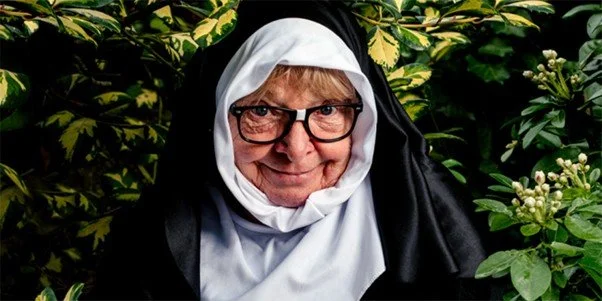
This is the first time I’ve met a playwright, is what I’m thinking. Certainly the first time I’ve met one who’s a septuagenarian, new to writing plays, and still high on Edinburgh energy after taking her show In the Lady Garden 27 times to the city’s month-long Fringe Festival a couple of summers ago. I’ve seen it, so I wade in early with a compliment. It’s one of my favourite recollections: a spit-your-coffee-out type of gag, Victoria Woodian in essence, about a woman who, unable to get to grips with her vibrator, simply froths up her Yorkshire pud batter with it instead.
Yet Babs’ skill is not simply in the steady stream of saucy one-liners. It’s in the artful meshing of comedy and pathos. Centre stage in the one-woman-show of Babs’ creation is protagonist-narrator Alice, played by actor Julia Faulkner. Alice, in monologue mode and in the dim light of a police cell, is reflecting on her life.
Alice, we soon figure out, was a young woman in the 1960s, a time and place where women like her were held back from ideas ‘above their station’ – their only ambition to keep sheets for their ‘bottom drawer’ in preparation for often ill-suited marriage.
Babs recalls that era and its expectations on women all too well. “Even if the men turned out to be sh*ts, like Alice’s Keith, that was considered better than being left on the shelf.”
Curious to know if some of Alice’s fictional experiences are Babs’ lived ones (though I fall short of asking her if she’s ever been ‘inside’), I pry. “I’d say 80% of In the Lady Garden is lived experience, so yes, I was writing it for myself really. The voice just came,” she says of the script that fell on to the page. It’s this, perhaps, that swayed the Edinburgh selection panel the day they gave her just two minutes to give her pitch one final push: “‘I was a girl at nursery school in the 1950s’,” I began. If you had a penis they’d say ‘Go and break windows with cricket balls! Go play with Lego! Have a jolly good time!’. Whereas if you had a vagina, they’d say ‘Off you trot to the home corner. Go play with the saucepans.’ It says it all really.”
At this point in our chat, it’s all too clear that I’ve done it again. That thing I do where I get so immersed in sparky conversation that I’ve forgotten that cafés are reliant on their revenue from hot drinks. The hovering waiter hasn’t, so sidles across to our table to nudge me. (No need to take Babs’; “The usual, Babs?”). To be fair, we’re deep in discussion about one particularly stirring scene, in which Alice recounts a childhood memory of her young brother prancing around starkers in the kitchen. Egged on by mum’s and aunt’s uproarious hooting (‘oh he’s a proper card, isn’t he!’), they reward his performance with a Custard Cream. Yet when young Alice kicks off her togs for a slice of the limelight, the response bears no biscuit. Instead, there are sharp draws of breath, commands to ‘stop showing off’, and enough signs of the cross to power a generator. A girl’s body must be a thing of filth, Alice is made to think. “And that’s just how it was in my generation,” says Babs. “Men decided how we should be. And the women backed them up.
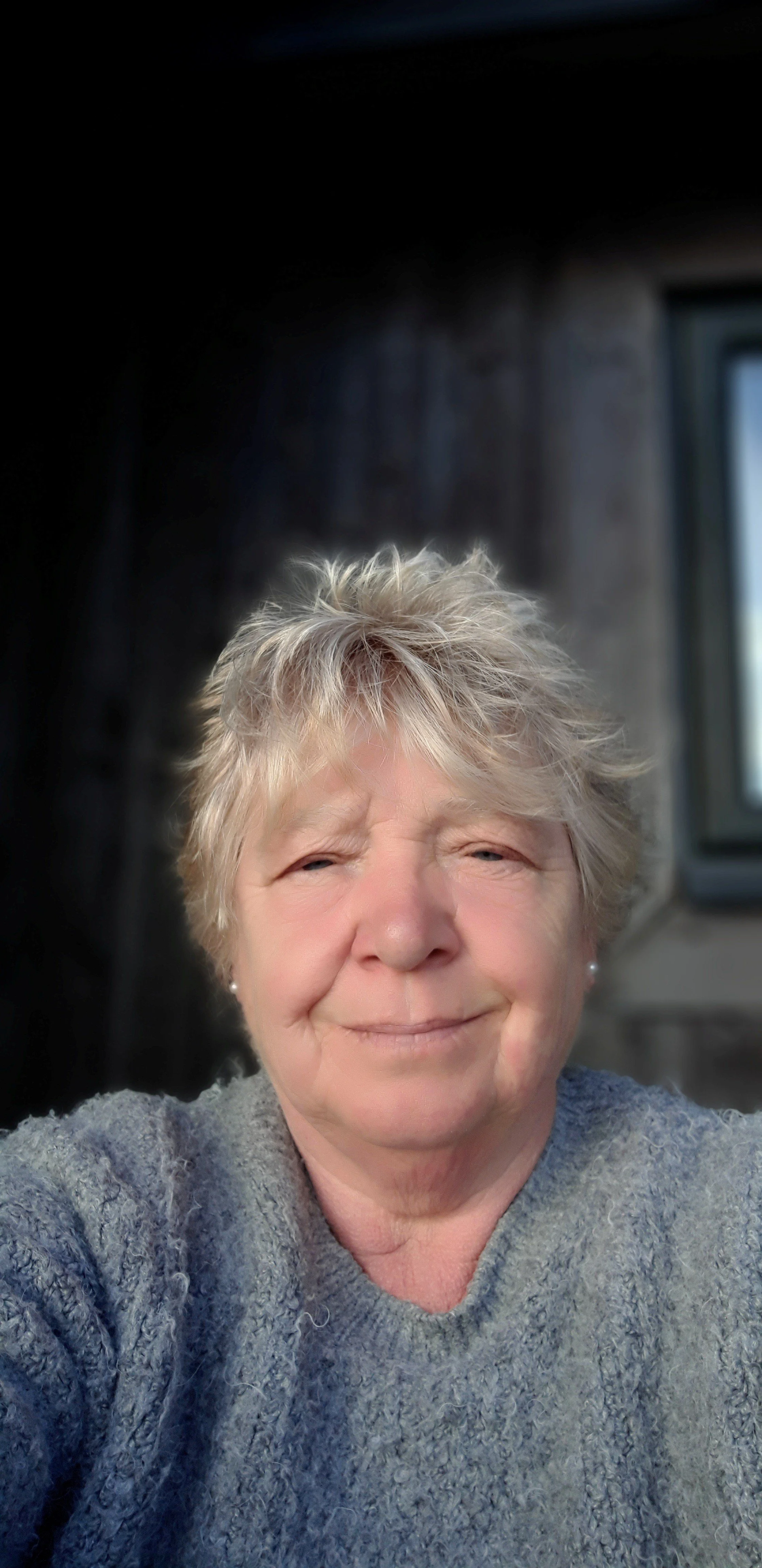
“That scene is an exact retelling of what happened to me as a child,” Babs continues, with an expression that suggests the maternal tuts are still ringing in her ears. And it’s one that resonated with audiences. “You could see from men’s faces [that it rang true]. Why is it that when a little boy did it, it was funny, yet when a little girl did it, she should be ashamed?”
A further scene that Babs borrows from real life recalls her 11-year-old self. When walking through a churchyard with a friend, a stranger offered them sweets before exposing himself. Yet when a police officer was summoned, the subsequent line of questioning appears to blame the girls rather than the perpetrator: ‘Why did you walk that way, girls?’, the police officer asked them. ‘Wasn’t there another way you could have gone?’; ‘Did you do anything to encourage this man?’
It was this childhood that laid the foundations for a a creative lifetime. Young Babs moved school six times (including to a convent school, hence the nuns of Alice’s narrative); eavesdropped on barmaids’ goss in her parents’ pub, and became smitten by the stage mid-Hamlet on a school trip. In later years, Babs taught English to young people on a psychiatric unit, then wrote three novels. And she’s not done yet, having just written a second play.
“It’s not just me,” says Babs, keen to cite examples of women who continue to accomplish despite being at an age they’re often overlooked. “Deborah [Edgington, who directs In the Lady Garden] left a job at 53 to do a theatre directing course. Incredibly brave. Julia [Faulkner, playing Alice] is at top of her game in her 60s.”
People, we agree, generally don’t expect older women to break out of themselves or achieve – nor could they predict Alice’s outcomes (no spoilers here). “I met a man recently who asked me what I did,” says Babs. “So I told him I was a novelist. He took one look at me, sized up my age and said he assumed I was self-published,” she eyerolls. “And that’s part of what the play’s about. The play never intended to use the idea that ‘it’s never too late’ as a cliché. It’s a call to action. Forget what people told you when you were three about playing in the home corner. That’s what the three of us want to say to women. Just do it. Just flipping do it. I‘ve learnt that it’s worth having the fear, worth the feeling of being exposed.
“In Edinburgh, there were days of self-doubt when I felt like a lost seven-year-old. But equally there were days when I felt I could conquer the world. And that’s because of the audience. Thoughtful crowds, raucous crowds, hen do’s, tons of blokes. Someone said he wished he’d brought his parents. Another said that she didn’t realise what women went through. A young lad said they’d never laughed so much.”
Now, there’s a compliment if ever I heard one, I say. “Yes,” laughs Babs, “but it’s definitely not for prudes.”
In the Lady Garden is on tour. Dates include 16 October (Stables Theatre Hastings), 22-24 November (Tabard Theatre Chiswick) and 9 January (Ustinov Theatre Bath). On Instagram, follow @the.ladygardeners and @hortonbabs for further dates plus updates on Babs’ new work Queenie.